EB Eishaan Bharadwaj

Insight · corridor thesis

Third Mumbai: the Atal Setu and airport corridor

Where Kharadi is the story of a re-rating that has finished, Third Mumbai is one that has barely started — and, unusually for India, the infrastructure it depends on already exists.

The argument in one line. The market has priced Ulwe for the airport and ignored Kharghar entirely. Whether that is an opportunity in Kharghar or a warning about Ulwe depends on one thing: whether you need the asset to pay you anything before year seven.

By Eishaan Bharadwaj · evidence dated September 2026 · infrastructure facts sourced below

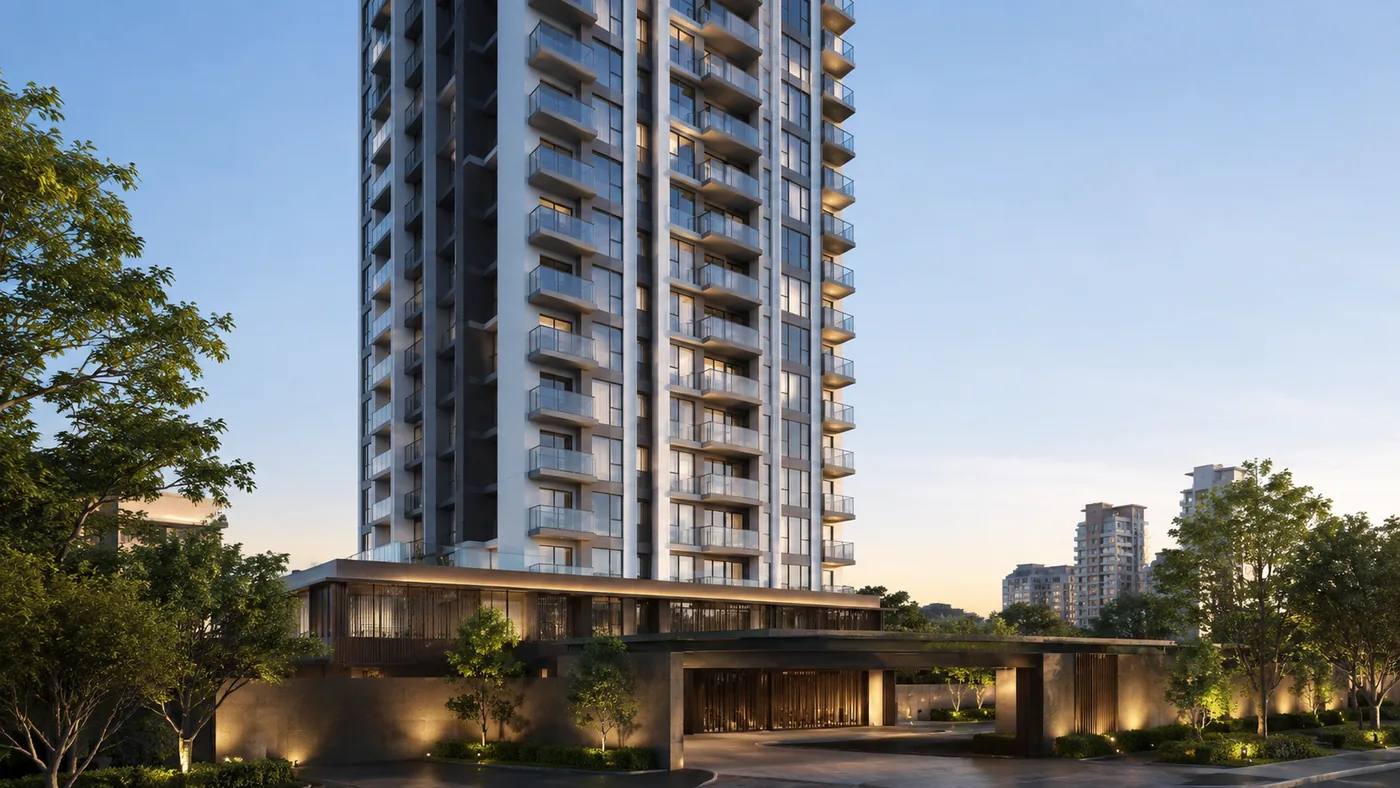
New residential tower at dusk with a lit landscaped entrance

The corridor

Infrastructure you can drive across

Most Indian location stories are sold on infrastructure that has been announced. The distinguishing feature of this one is that it exists.

Illustrative of the asset type and specification discussed on this page. Not a photograph of this locality, and not a project offered for sale.

What has actually been delivered

Three facts, all verifiable, none of them forecasts

Most Indian location stories are sold on infrastructure that has been announced. The distinguishing feature of this one is that you can drive across it.

January 2024

The Atal Setu is open

The Mumbai Trans Harbour Link: 21.8 km in total, 16.5 km of it over water, six lanes, Sewri to Nhava Sheva. Built by MMRDA at ₹17,843 crore, inaugurated 12 January 2024 and open to traffic from the 13th. India's longest sea bridge.

December 2025

The airport is flying

Navi Mumbai International Airport began commercial operations on 25 December 2025. Phase 1 is built for 20 million passengers a year plus half a million tonnes of cargo through one terminal; full build-out targets 90 million across four terminals and two parallel runways. It sits inside Ulwe.

Since 2013

NAINA is a planned region

The Navi Mumbai Airport Influence Notified Area, notified January 2013 with CIDCO as special planning authority, covering villages across Panvel, Uran and Pen talukas. An Interim Development Plan is sanctioned and delivery is proceeding scheme by scheme through Town Planning Schemes.

On NAINA's size: published figures conflict — one source says roughly 170 villages, another 461 sq km across 224. I have not been able to confirm either against CIDCO's own gazette notification, so I describe it qualitatively rather than quote a number I cannot stand behind.

Evidence

What the two markets are actually priced at

Asking-price aggregates from third-party locality reports, read September 2026. Asks, not registered transactions — which in this corridor is the whole point.

Ulwe and Kharghar · September 2026
 UlweKharghar
Average asking rate₹15,600 / sq ft₹18,500 / sq ft
Year-on-year movement+5.44%−0.05%
Gross rental yield2.54%3.11%
Average asking rent₹33 / sq ft / month₹50 / sq ft / month
Portal registration-related figure (basis unverified)₹13,700 / sq ft₹15,050 / sq ft
Difference from asking price (descriptive only)~12%~19%

Ulwe carries the fastest growth and the lowest yield of the eight markets I track. Kharghar carries the widest ask-to-registry gap of the eight. Neither of those is a small detail.

The read

Two markets, two instruments, one node

Judgement, stated as judgement

Ulwe is a seven-to-ten year position, or it is a mistake. A 2.54% gross yield is close to no income at all once costs are taken out — it will not service a loan and it will not cover the holding. What you are buying is the difference between an airport that generates traffic and a node that generates jobs, and that gap is measured in years, not quarters. For capital that genuinely needs nothing back in the meantime, that is a legitimate trade. For anyone who might need to sell inside five years it is a poor one, because your exit buyer depends on employment that has not arrived yet.

Entry price needs its own evidence. Compare the specific unit with verified transactions on the same area basis. A difference between two portal averages does not establish a discount, an achievable sale price or a future return.

Kharghar offers a different starting point. Its existing residential population and amenities merit assessment alongside the airport-led argument for Ulwe. Compare the property’s condition, access, rent and actual transaction evidence before choosing.

What would change my view. Confirmed office absorption inside the NAINA region — not announced, absorbed — would move Ulwe from an infrastructure bet to an employment story, which is a materially better asset. Conversely, a second year of flat Kharghar with the gap unclosed would suggest the ask is simply wrong rather than early.
The connective tissue

The roads that decide which node wins

Both are under construction. Their delivery dates are the closest thing this corridor has to a schedule you can underwrite against.

Ulwe Coastal Road

5.8 km plus a 0.9 km airport link, connecting the Atal Setu at the Shivaji Nagar interchange directly to the airport via Seawoods, Ulwe, Bamandongri and Targhar — bypassing the earlier detour. As of late October 2025, Phase 1 was around 60% complete and Phase 2 around 30%, with full opening expected October–November 2026. Cost rose from ₹700 crore to ₹1,591 crore after a redesign onto stilts to preserve mangroves.

This is the road that makes Ulwe's airport adjacency real rather than notional.

Kharghar Coastal Road

9.678 km, 30 m wide, with a grade-separated interchange over the Sion–Panvel Expressway, connecting the airport to Belapur and Nerul. Contract awarded; construction was expected to begin in early 2026 pending forest clearances, with completion targeted 2029.

Kharghar's connectivity upgrade is three years behind Ulwe's. That is part of why the market has priced them the way it has — and part of why the pricing may be excessive.

Considering an entry in this corridor?

Share the property you are considering, and we can discuss which comparable transactions and costs need checking before you agree a price.

WhatsApp