EB Eishaan Bharadwaj

Insight · buyer process

Carpet area vs built-up vs saleable area

One of these three is defined in Indian law. The other two are trade conventions, and the difference between them is where a quoted price per square foot stops meaning anything at all.

The short version. Carpet area has a statutory definition, in Section 2(k) of the Real Estate (Regulation and Development) Act, 2016. Built-up area and super built-up or saleable area have no definition anywhere in that Act. A rate per square foot is meaningless until you know which of the three it is quoted on.

By Eishaan Bharadwaj · published 3 September 2026

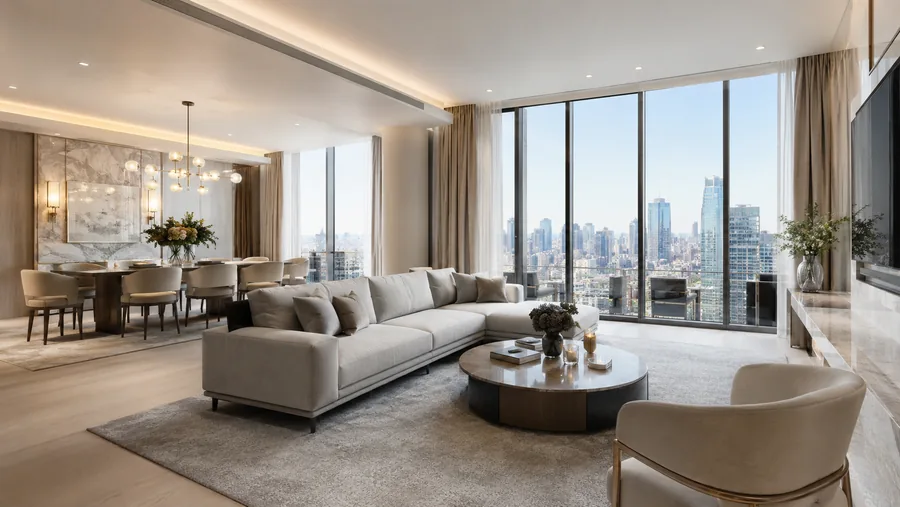
Open living and dining space with full-height glazing onto mature trees

What you are actually buying

The only area figure with a legal meaning

Carpet area is defined in statute. Built-up and super built-up are trade conventions with no definition in the Act at all.

Illustrative of the asset type and specification discussed on this page. Not a photograph of this locality, and not a project offered for sale.

The statute

What the Act actually says

Quoted in full, because paraphrases of this definition circulate widely and most of them are wrong in at least one clause.

“carpet area” means the net usable floor area of an apartment, excluding the area covered by the external walls, areas under services shafts, exclusive balcony or verandah area and exclusive open terrace area, but includes the area covered by the internal partition walls of the apartment.

Section 2(k), Real Estate (Regulation and Development) Act, 2016

Reading it carefully

Internal walls are in. This surprises people. The area under partition walls inside your apartment counts as carpet area. External walls do not.

Balconies and terraces are out — but only the exclusive ones, and the Act attaches an explanation clarifying that “exclusive” means for the exclusive use of the allottee. They are excluded from carpet area, which is why the registered declaration states them separately.

Service shafts are out. The area under ducts and shafts passing through the unit does not count.

Under Section 4(2)(h), a promoter registering a project must declare the number, type and carpet area of the apartments for sale, together with the exclusive balcony or verandah areas and the exclusive open terrace areas. Under Section 13 and the notified Model Agreement for Sale, the agreement itself states the unit's carpet area. Some state regulators have gone further — Haryana RERA gazetted a regulation stating apartments may be sold only on a carpet area basis, treating anything else as an unfair practice.

So the accurate statement is this: under RERA, apartments are registered, agreed and sold on the basis of carpet area, a term the Act defines. Built-up and super built-up area have no definition in the Act at all.
The three measures

What each one includes, and who uses it

The three area conventions in Indian residential sale
MeasureStatutory?What it includesWhere you meet it
Carpet area Yes — s.2(k), RERA 2016 Net usable floor area inside the apartment, including internal partition walls. Excludes external walls, service shafts, exclusive balconies and exclusive open terraces. The RERA registration, the agreement for sale, the sale deed. The only figure with a legal meaning.
Built-up area No Convention: carpet area plus the area under internal and external walls, and usually balconies. Typically 10–15% above carpet, but the figure is a convention, not a rule. Building bye-laws and development control regulations use the term. Sales conversations use it loosely.
Super built-up / saleable area No Convention: built-up area plus a proportionate share of common areas — lobbies, staircases, lifts, clubhouse, sometimes amenity space. There is no standard for what may be loaded in. Brochures, hoardings, price-per-square-foot quotes. The largest of the three, which is why it is quoted.

The arithmetic

What a loading factor does to a price

This is the whole practical point, and it takes one worked example. The numbers below are an illustration, not a quote for any actual property.

Worked example

Two units are advertised. Both quote ₹14,200 per square foot, the September 2026 Kharadi asking average. Both advertise 1,200 square feet. Both therefore cost ₹1.70 crore.

Unit A is quoted on saleable area with a 25% loading. Its carpet area is 1,200 ÷ 1.25 = 960 sq ft. The effective rate on what you can actually walk on is ₹1.70 crore ÷ 960 = ₹17,750 per sq ft.

Unit B is quoted on saleable area with a 35% loading — not unusual in amenity-heavy projects. Its carpet area is 1,200 ÷ 1.35 = 889 sq ft. The effective rate is ₹19,167 per sq ft.

Same advertised rate. Same advertised size. Same cheque. Unit B gives you 71 square feet less floor, and costs 8% more per usable foot. Nothing in either advertisement is false.

The rule that follows. Never compare two properties on rate per square foot until both are restated on carpet area. Ask for the carpet area figure in writing — the developer has already declared it to the regulator, so there is no reason it should be difficult to produce. If it is difficult to produce, that is your answer about the project.

Before you sign

Five questions worth asking in writing

On area

  • What is the carpet area as declared in the RERA registration for this specific unit type?
  • What are the exclusive balcony and exclusive open terrace areas, stated separately?
  • What is the loading factor, and what specifically is loaded into it?

On price

  • Restate the rate per square foot on carpet area, so it can be compared with anything else.
  • What is the fully-loaded cost — stamp duty, registration, GST where applicable, floor rise, parking, club charges, maintenance deposit, infrastructure charges? This routinely adds 12–18% to the headline.

This page explains statutory definitions and arithmetic. It is not legal advice, and it does not cover state-specific variations in stamp duty or development control regulation. Verify the registration and the declared areas against the official MahaRERA register, and take a title opinion from your own advocate.

Send me the brochure.

Give me the advertised rate and size and I will restate it on carpet area and give you the fully-loaded cost. It takes about ten minutes and it is free.

WhatsApp